Where People Go Wrong
Most of the trouble calls we get start the same way: someone sprays the track with whatever's under the sink, the door moves smoother for a week, and then it locks up hard on a cold morning. Most houses in the Boone service area went up between 1968 and 1997, so a lot of the torsion hardware on original doors is coming up on fifty years of winding and unwinding. People treat a stiff door like a lubrication problem when it's actually a spring that's lost tension, or a cable that's frayed from decades of the same steel flexing in weather it was never rated for indoors. The other common mistake is waiting. A door that groans on the way up in December usually isn't asking for oil - it's asking for a tension adjustment before the spring goes all at once, usually with the door standing open on one hand-height cable. We also see owners replace an opener because the door 'won't open' when the actual failure is the spring, and the opener motor is just straining against a load it was never built to lift alone. Fixing the wrong part costs twice: once for the part you didn't need, and again for the one you still do.
Checking It Yourself
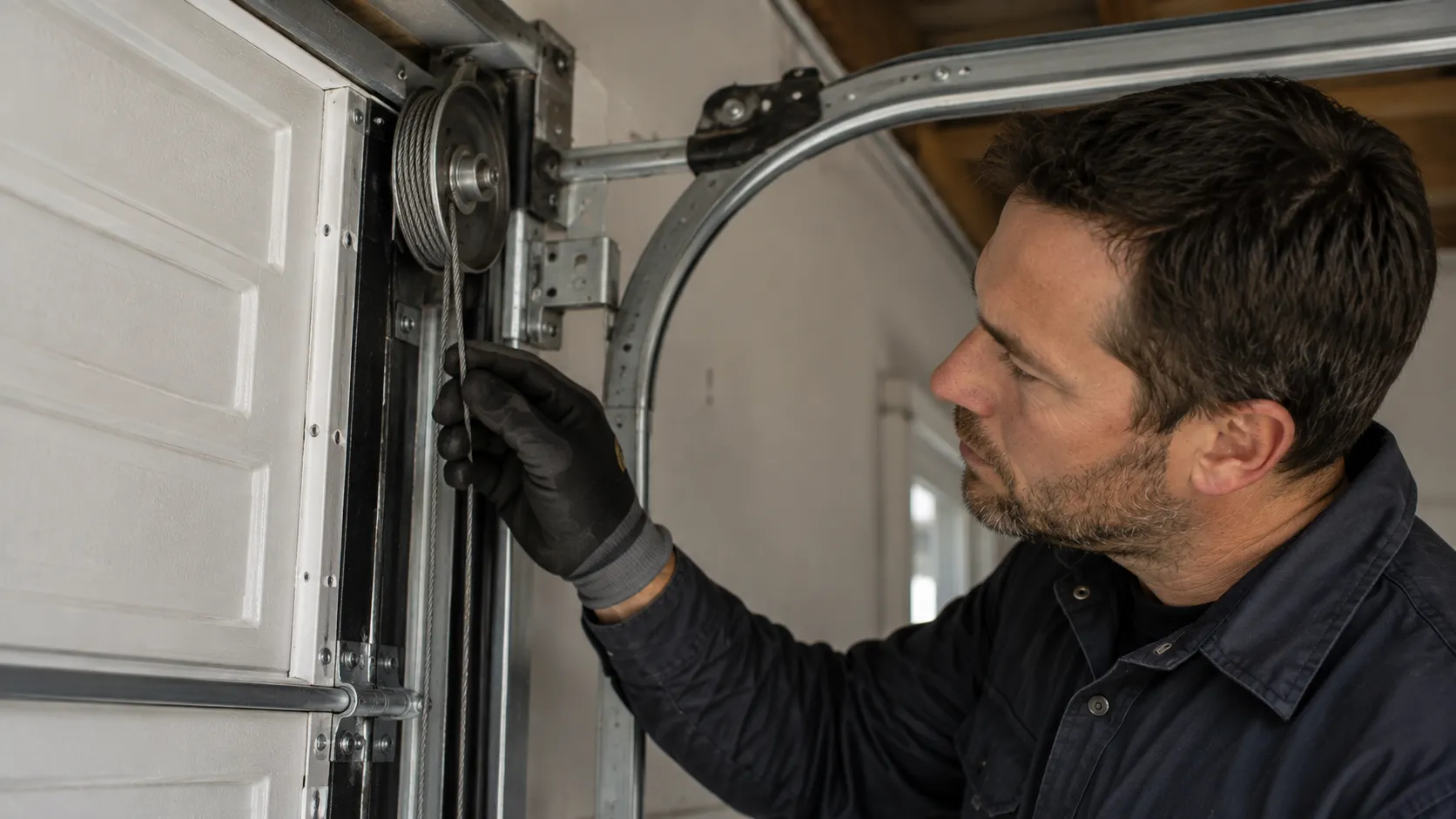
Pull the release cord, put the door about halfway down, and let go. A properly balanced door holds still. If it drifts up or drops down, the springs are off and no amount of oil fixes that - it's a tension job. Next, look at the torsion bar above the door on the wall over the header. On the 1960s and 70s stock that makes up most of this area, that bar and the winding cones are usually original, and rust or dry-rot on the mounting bracket wood is common enough to check every fall. Listen for a stiff, hesitating start in the first foot of travel, especially first thing in the morning when the steel's coldest - that's a wind-tension issue, not a track issue. Check the rollers by hand: if they wobble side to side more than a little, they're near the end of their life. What you can't safely check yourself is spring tension itself. A torsion spring under full load has enough stored energy to break a wrist or worse, and it's the one part on this job we don't recommend a homeowner touch, even a careful one. If the balance test fails, that's the point to call rather than the point to keep adjusting.
What Is Going On
On a door installed during the 1968 to 1997 building wave that covers most of this area, the springs, hinges, and rollers are almost always original or a straight one-for-one replacement of the original size. That matters because insulated panel doors sold since then are heavier than what those springs were sized for. So even a spring that hasn't broken yet is often working harder than its rating, which shortens its life and puts more strain on the opener's gear and the top bracket where the cable anchors. Across the 3,578 households and 4,331 owner-occupied houses we cover, from Blowing Rock six miles out to Jefferson eighteen miles down the road, the hardware era repeats itself - so does the failure pattern. Ten named areas of mostly 1960s and 70s stock share the same problem: springs sized for a lighter door, then a heavier insulated replacement panel hung on the same hardware. A service call usually means checking spring wind count against door weight, inspecting the cable and drum for wear grooves, and testing the opener's force settings, which drift over years and either strain the motor or fail to detect an obstruction properly.
What the Weather Here Does to It
Boone sits in a climate band rated severe cold, which means steel springs contract and torsion tension changes more than it would somewhere with a mild winter. Cold steel is stiffer and slightly less elastic, so a spring that was balanced correctly in August can feel noticeably tighter or looser by January - not because anything broke, but because the metal itself behaves differently at low temperatures. Grease and lubricant thicken in the cold too, which is why a door that ran fine all summer can start hesitating on the first cold snap; it's not always a part failing, sometimes it's just old grease that's gone stiff and needs to be cleaned off and replaced with something rated for the temperature swing this area sees. With a median household income of $81,346 in this area, most owners here can afford to replace a worn opener rather than nurse a 1970s chain-drive unit along, and in a severe-cold climate that's often the more sensible call - older gear-and-track openers weren't built with cold-rated lubricant or sealed circuit boards, and they show it every winter that a newer unit wouldn't.
Talk to a local pro
Garage door trouble in Boone?
Same-day service with honest, upfront quotes.